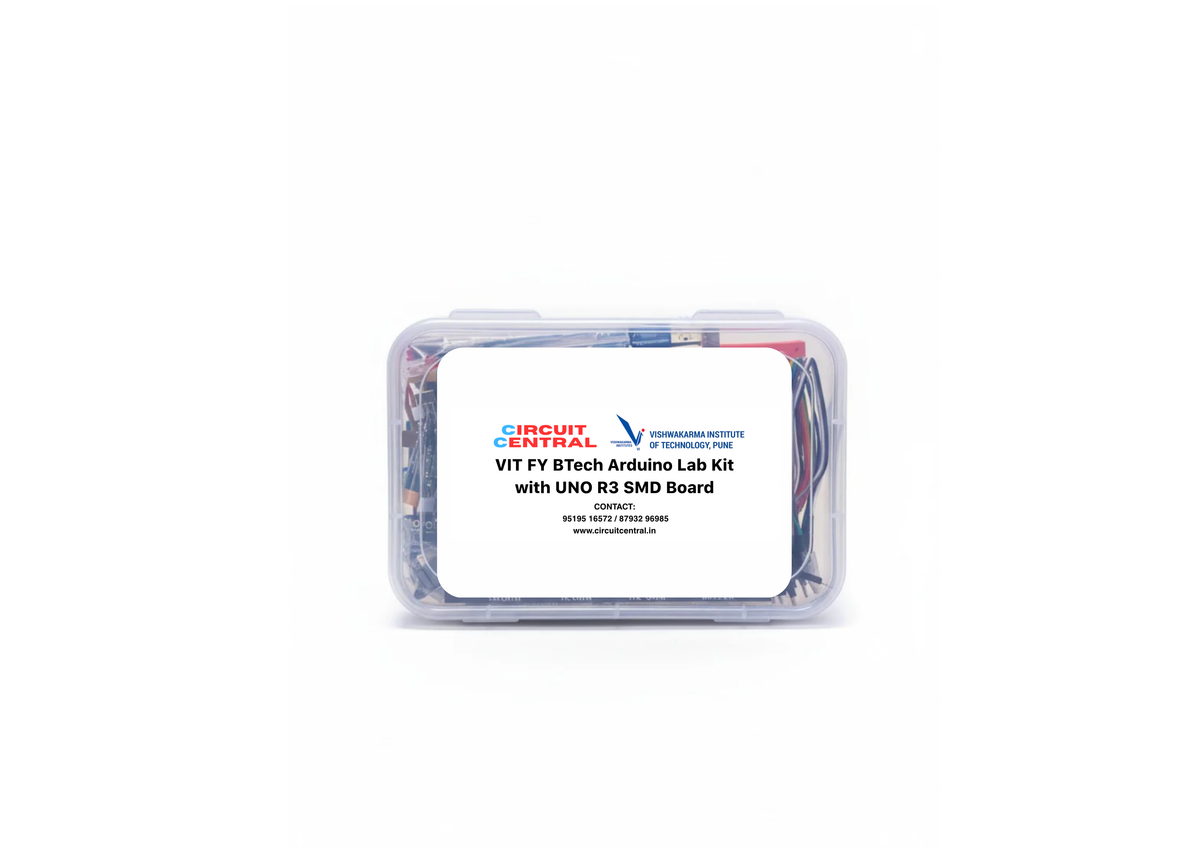
VIT FY BTech Arduino Lab Kit with UNO R3 SMD Board
VIT FY BTech Arduino Lab Kit with UNO R3 SMD Board
Couldn't load pickup availability
The Circuit Central VIT FY BTech Arduino Lab Kit (Budget Edition) includes every component needed for practicals 2 to 11 in the A.Y. 2026-27 syllabus, paired with an Arduino UNO R3-compatible SMD board. It's the lower-cost option for students who want the full practical set without the official board.
The board uses the ATmega328P microcontroller in the classic UNO R3 layout and programs directly from the Arduino IDE. Every experiment in the practicals list runs on it.
Practical-by-Practical Coverage
| No. | Practical | Components Included |
|---|---|---|
| 2 | LED blinking | UNO R3 SMD board, 5mm LEDs, 470Ω resistors |
| 3 | LED array / Traffic signals | Red, yellow and green LEDs, 470Ω resistors |
| 4 | Interfacing LDR | LDR, 10kΩ resistor |
| 5 | Ultrasonic sensor | HC-SR04 ultrasonic sensor |
| 6 | IR sensor module | IR obstacle sensor module |
| 7 | Temperature sensor | LM35 analog temperature sensor |
| 8 | 16x2 LCD (with I2C) | 16x2 LCD with pre-soldered I2C module |
| 9 | 7-segment display, 4-digit module | Single-digit 7-segment display, TM1637 4-digit module |
| 10 | PMDC motor | DC motor, L298N motor driver, 4xAA battery holder |
| 11 | Servo motor | SG90 micro servo |
Practical 1 (Virtual Lab) and practicals 12 to 14 (MATLAB/Simulink) are software-only and need no hardware.
What's in the Box
- 1 x UNO R3-compatible SMD board (ATmega328P)
- 1 x USB cable
- 1 x 830-point breadboard
- 1 x HC-SR04 ultrasonic sensor
- 1 x IR obstacle sensor module
- 1 x LM35 temperature sensor
- 1 x LDR (photoresistor)
- 1 x 16x2 LCD with I2C module (pre-soldered)
- 1 x TM1637 4-digit 7-segment display module
- 1 x Single-digit 7-segment display (common cathode)
- 1 x DC motor (3–6V)
- 1 x L298N motor driver module
- 1 x SG90 micro servo motor
- 1 x 10kΩ potentiometer
- 10 x 5mm LEDs (red, yellow, green, white)
- 10 x 470Ω, 5 x 1kΩ, 5 x 10kΩ resistors
- 40 x male-to-male and 20 x male-to-female jumper wires
- 1 x 4xAA battery holder (batteries not included)
- 1 x Storage box
Board Specifications
| Microcontroller | ATmega328P (SMD), 8-bit AVR, 16 MHz |
| Memory | 32 kB flash, 2 kB SRAM, 1 kB EEPROM |
| Operating voltage | 5 V |
| Recommended input voltage | 7–12 V |
| Digital I/O | 14 pins, 6 with PWM |
| Analog inputs | 6 pins, 10-bit ADC |
| Communication | UART, SPI, I2C |
Official or Budget: Which Should You Pick?
Your syllabus names the Arduino UNO EK R4 Minima. If your lab or faculty requires the exact board, choose our Official UNO एक R4 Minima kit, which adds a 32-bit processor and far more memory. If you want to practise at home or keep costs low, this edition covers the same practicals with the same components and wiring.
Built by VIT Students, for VIT Students
Circuit Central is run by VIT alumni. We started the company four years ago, in our first year at VIT, and ran it alongside our degrees until we graduated in June 2026. In that time, we have supplied practical kits to four batches of VIT students.
We did these same practicals ourselves, so we know exactly which components each experiment needs and where students tend to get stuck. Every kit is put together from a student's point of view, so nothing is missing when you sit down to build.
Why Your Own Kit Matters, Even If Your Lab Has One
Lab sessions are short and lab kits are shared. With your own kit, you can repeat an experiment at home, try your own variations, make mistakes and fix them. That hands-on practice is what turns a practical you completed into a concept you actually understand.
Your First Step Into Robotics
As AI moves from software into machines, the demand for robotics skills is growing fast. Every robot, from a line-follower to an industrial arm, is built on the fundamentals this kit teaches: reading sensors, driving motors and displaying data. Once these basics are clear, you can move on to more advanced projects, and every component you need for them is available at Circuit Central.
Frequently Asked Questions
Will the practicals written for the UNO R4 Minima work on this board?
Yes. Both boards share the UNO pin layout and 5 V logic, so the wiring is identical and standard sketches for these practicals run on both.
Do I need a driver for the board?
Most computers detect the board automatically. If yours doesn't, install the free USB-serial driver once.
Is this an official Arduino board?
No. It's an Arduino UNO R3-compatible board. For the official board, see our UNO एक R4 Minima kit.
How should I power the servo?
Power the SG90 from the included 4xAA battery holder and connect its ground to the board's GND. This keeps the board stable when the servo moves.
Do I need anything else to start?
A laptop with the Arduino IDE and four AA batteries. Everything else is in the box.
Who runs Circuit Central?
Circuit Central is run by VIT alumni who started the company in their first year and have supplied practical kits to four batches of VIT students.
Circuit Central is an independent business founded and run by VIT alumni. It is not officially affiliated with or endorsed by Vishwakarma Institute of Technology.
Share